

O que é tokenização? Entenda o significado desta tecnologia e como ela protege os seus pagamentos, representa ativos em blockchain e ajuda a IA a compreender a linguagem.
What is Tokenisation? Meaning in Payments, Crypto & AI (AU)
What is Tokenisation? Meaning in Payments, Crypto & AI (AU)
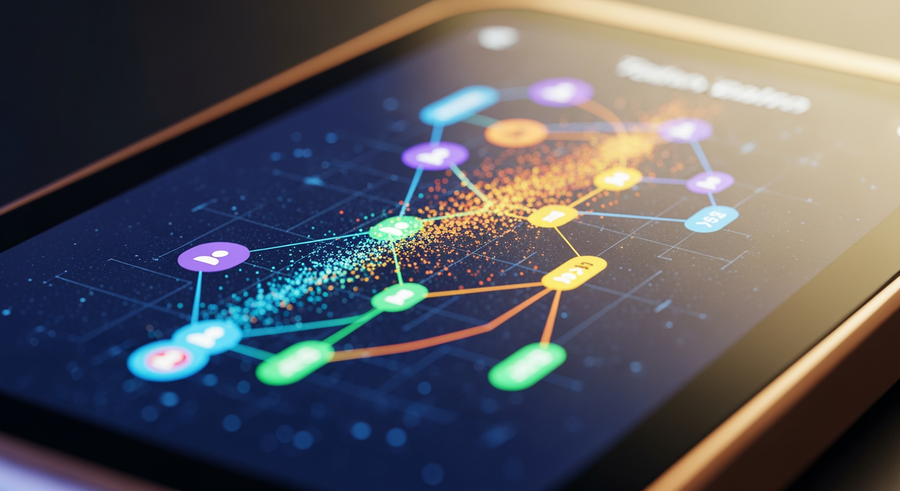
Understanding the Core Tokenisation Meaning
Tokenisation is the process of replacing sensitive data with a non-sensitive equivalent, referred to as a “token”. This token is a unique identification symbol that stands in for the real data, retaining all the essential information without compromising its security. While you might see this term spelled as ‘tokenization’ in American English, here in Australia, we use the ‘s’ spelling. The concept is now a global standard for security and digital asset management, playing a critical role in how we interact with technology every day.
At its heart, the idea is simple enough to translate across any language, whether you’re searching for its meaning in Hindi, Tamil, Telugu, or Urdu. In plain English, tokenisation is like turning a real thing into a secure digital code. Think of it like a casino chip: the chip itself isn’t valuable, but it represents a specific amount of real money held safely in the casino’s vault. The token works the same way for data.
To help you understand its full impact in 2026, we’ll explore tokenisation across the three main pillars where it has become essential:
- Payments & Banking: Where it provides top-tier security for your financial data.
- Blockchain & Crypto: Where it represents ownership of real-world assets.
- Artificial Intelligence (AI): Where it helps machines understand human language.
Summary
This guide explains what tokenisation means in Australia and how it impacts your daily life. You’ll learn how this technology keeps your payments secure, how it’s changing the way we own assets like real estate through crypto, and how it allows AI like ChatGPT to understand what you’re writing. We break down the key differences between tokenisation in finance, blockchain, and artificial intelligence, so you can see how one core idea powers so much of the modern digital world.
TLDR
- What is It?: Tokenisation is the process of swapping sensitive data (like your credit card number) for a unique, non-sensitive placeholder called a “token”.
- In Banking: It protects your financial details during online shopping or tap-to-pay transactions, making them super secure.
- In Crypto: It turns real-world assets like property or art into digital tokens on a blockchain, allowing for easier trading and fractional ownership.
- In AI: It breaks down your sentences into small pieces (tokens) that computer programs can understand and process.
- Is it Safe?: Yes, especially for payments, it’s a gold standard for security.
📑 Table of Contents
Jump straight to the section you’re most interested in:
Payment Tokenisation in Banking and Finance
The tokenisation meaning in banking is all about security. When you buy something online or use a digital wallet, tokenisation is the invisible process that protects your card details. Instead of sending your actual 16-digit Primary Account Number (PAN) across the internet, the payment system replaces it with a randomly generated, one-time-use token. This token is then sent to the merchant for processing.
The primary benefit of this system is that it prevents credit card fraud. The merchant never sees or stores your real card number. If a hacker were to intercept the transaction or breach the merchant’s database, they would only get the useless, single-use token. The actual card details remain locked away in a secure digital “vault” managed by the payment processor (like Visa or Mastercard). Without the key to that vault, the token is just a meaningless string of characters.
For you as a user, this entire process is completely seamless. It happens in the background in a fraction of a second every time you make a purchase when using Apple Pay, Google Pay, or when you use a saved card on a site like Amazon. This is the core of payment tokenisation: maximum security with zero extra effort from the consumer.
Tokenisation of Assets in Crypto and Blockchain
When we discuss the tokenisation meaning in crypto, we’re shifting from security to ownership. Asset tokenisation is the process of creating a unique digital token on a blockchain that represents ownership of a real-world asset (RWA). This token acts as a digital deed or certificate, securely recorded on a decentralised ledger.
This innovation is breaking down traditional investment barriers. High-value, illiquid assets that are typically hard to sell or divide can now be “tokenised”. Imagine a commercial office building in Sydney worth millions of dollars. Through tokenisation, its ownership can be divided into thousands of digital tokens, each representing a tiny fraction of the property.
📈 Tokenised Stocks
Instead of buying a full, often expensive, share in a company, you can buy a token that represents a fraction of that share. This makes investing in major global companies more accessible to everyday Australians.
🏠 Tokenised Real Estate
This allows investors to buy into the property market with a much smaller amount of capital. You could own a digital “brick” in a building, earning a share of the rental income and property appreciation.
The benefits of tokenising assets are transforming finance:
- 💧 Liquidity
- It makes traditionally illiquid assets (like art or real estate) easy to buy and sell on digital marketplaces, 24/7.
- 🧑🤝🧑 Accessibility
- It opens up high-value investment opportunities to a wider range of people by allowing for fractional ownership. You no longer need millions to invest in commercial property.
- 🔍 Transparency
- Every transaction and ownership record is stored on the blockchain, creating an immutable and transparent history that anyone can verify.
Tokenisation in AI and Natural Language Processing (NLP)
The tokenisation meaning in AI and Natural Language Processing (NLP) is completely different again. Here, it’s not about security or ownership, but about data processing. Large Language Models (LLMs) like ChatGPT don’t read words and sentences the way humans do. To make sense of our text-based prompts, they must first break them down into smaller, manageable pieces called “tokens”.
💡 How AI Reads Your Words
The process is straightforward but crucial for how AI works:
- Chopping Up Text: When you type a sentence, the AI program first “tokenises” it. This means chopping it into individual words, parts of words (subwords), or even single characters. For example, the word “tokenisation” might become two tokens: “token” and “isation”.
- Converting to Numbers: Each unique token is then assigned a number from the AI’s vast vocabulary. The sentence “What is tokenisation?” becomes a sequence of numbers like [52, 12, 11254, 30].
- Processing: The AI processes these numbers, not the original text, to understand context, relationships, and meaning, before generating a response.
As a rule of thumb, for English text, 1 token is approximately 0.75 words. So, 100 tokens is about 75 words.
Why does this matter? The way an AI model is designed to tokenize text directly impacts its performance. Better, more efficient tokenisation allows the AI to understand language nuances, grammar, and context more accurately. This is fundamental for everything from translation services to the powerful chatbots we interact with daily.
Frequently Asked Questions (FAQ)
What is the difference between encryption and tokenisation?
While both are security methods, they work very differently. Encryption uses a mathematical algorithm and a “key” to scramble data into an unreadable format. The data can be unscrambled back to its original form using the correct key. Tokenisation, on the other hand, completely replaces the sensitive data with a non-sensitive token. The original data is stored in a separate, secure vault. You can’t reverse-engineer the token to find the original data; you can only use it as a reference. For payment processing, tokenisation is generally considered more secure because the actual data never even enters the merchant’s system.
What is a token in simple terms?
A token is a digital stand-in or a placeholder. It has no value or meaning on its own, but it represents something valuable that is stored securely somewhere else. Think of it as the claim ticket you get at a coat check – the ticket itself is just paper, but it represents your valuable coat. In finance, it represents your money; in crypto, it can represent ownership of a house; in AI, it represents a word or part of a word.
Is tokenisation safe?
Yes, absolutely. In the context of payments, it is considered the gold standard for security. By removing your actual credit card number from the transaction process that merchants handle, it dramatically minimises the potential damage from security incidents. It is one of the most effective methods for reducing the risk of data breaches, which is why it has been widely adopted by all major financial institutions and payment providers worldwide.
How does tokenisation apply to different languages?
This is a great question that ties back to tokenisation in AI. When processing languages like Hindi, Tamil, or Urdu, which have different scripts and grammatical structures than English, AI models need specialised tokenisers. A standard English-based tokeniser would be inefficient, breaking down words from these languages into meaningless individual characters. Therefore, NLP models are trained with specific programs that understand the unique rules and character sets of each language, allowing them to convert text into machine-readable tokens far more accurately and efficiently.
Written by
Ruby Walker
